

Introduction
Levery is a compliance-first, white-label DeFi exchange stack designed for regulated institutions that want to offer on-chain markets without rebuilding core trading infrastructure, access controls, and operational guardrails from scratch.Levery core capabilities
Levery bundles everything a regulated Virtual Asset Service Provider (VASP) needs to run a branded DeFi trading venue. The stack provides a complete environment, aligned with the institution’s brand and policies, incorporating the controls and interfaces required by risk, compliance, treasury, and operations teams.White-Label Client Platform
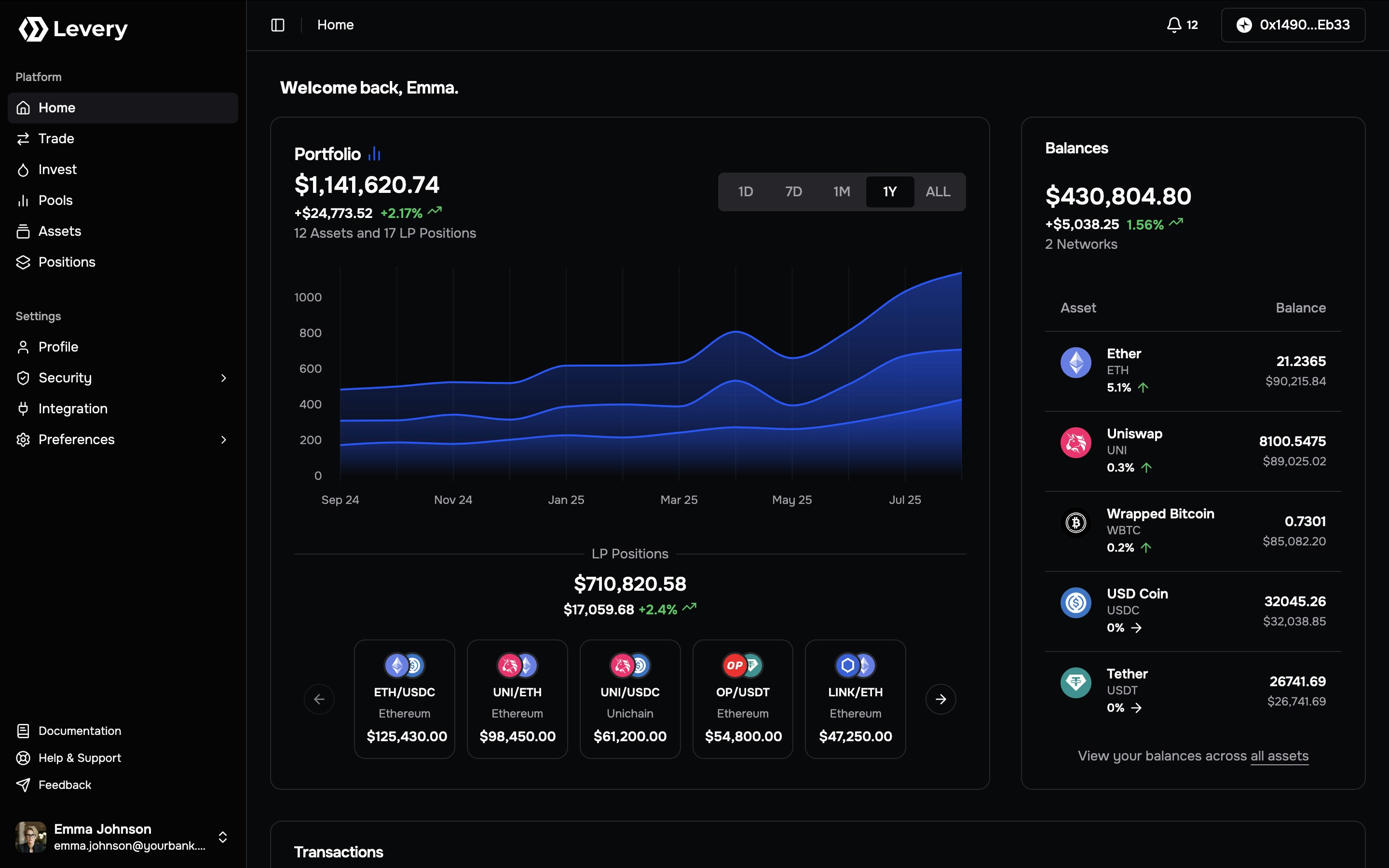
Admitted customers interact through a fully branded user interface within a streamlined trading and portfolio view.
Institution Admin Console
The console handles KYC/KYB review and wallet admission, asset policies, real-time monitoring and management of user
permissions.
Liquidity Pool Creation
Through the console, the institution configures and launches permissioned pools and can allocate ring-fenced house
liquidity.
Access Control
All client entities must complete KYC/KYB to join the venue. Once approved, designated wallets are admitted and linked
to the legal entity.
Pre-Trade Checks
Before any swap or liquidity action, policies are checked by the smart contracts ensuring consistent, audit-ready
enforcement.
Post-Trade Records
Each action emits standardized, timestamped events that populate client statements and operator dashboards.
API Integration
Secure, well-documented APIs for deep integration with banking systems, compliance engines, reporting tools, and
client portals.
Monitoring Dashboard
A comprehensive monitoring and audit dashboard gives operations, compliance, and risk teams real-time visibility into platform activities.
This documentation explains how Levery works and how to integrate and operate it. It’s not legal advice.
Always validate requirements with your compliance and legal teams for your jurisdiction.
Design principles
Levery is engineered around a set of architectural principles that keep policy, risk controls, and operational responsibilities explicit, enforceable, and auditable across every market and participant.Permissioned AMM Engine
Before any state change, Levery runs on-chain admission and risk checks. Non-compliant calls revert deterministically
with clear reasons; compliant actions execute normally, so that only authorized accounts can access pools and add or
remove liquidity.
Auditable On-chain Execution
There is no third-party custody or intermediation in the execution path, assets move under the control of smart
contracts. Code and state are immutable once deployed, execution is deterministic across validators, and every state
transition is recorded on the ledger, producing a tamper-evident audit trail.
Oracle-Guided Dynamic Fees
Levery integrates market-price oracles to support fair pricing and dynamic fee calculations. The engine monitors
oracle-to-pool divergence, adjusting fees in real time to anchor execution to an external reference while balancing
competitive pricing with liquidity-provider protection.
Non-Transferable Positions
Liquidity positions are tokenized as special ERC-721 that are non-transferable, binding each position to its verified
owner. This design enforces KYC/KYB status across the entire LP lifecycle, prevents unauthorized transfers, and
simplifies compliance reporting.
Administrative Controls
On-chain administration functions allow institutions to update administrators, adjust fee parameters globally or per
pool, update oracle references, and reset the permission manager when required by procedure.
Configurable Service Fee
A programmable service fee routes to a secure vault, enabling transparent treasury and revenue-sharing models.
Accruals and distributions are executed by contract and recorded on-chain, giving teams clear accounting.
Key concepts you’ll see everywhere
These concepts are the “language” of Levery. Getting comfortable with them early makes the rest of the docs much easier.Security audit
Levery’s smart-contract suite is audited by Runtime Verification, a Chicago-based security audit firm globally recognized for more than a hundred publications and tools that shaped the field. Active in blockchain security since 2017, the team has served high-TVL protocols including Ethereum, Uniswap, Lido, Maker, and Optimism. The mission was to move beyond code review and establish whether critical properties hold in all admissible executions, using mathematically grounded techniques in addition to conventional analysis.Next steps
Choose your path based on your role and what you need next:What is Levery
Product overview, key differentiators, and institutional digital asset stack.
Architecture
A technical view of on-chain components and end-to-end flow.
Security
Review Levery’s security posture and the smart-contracts audit report.
Institutional Deployments
Single tenant deployment options for regulated institutions with trust boundaries and strong governance.
End-User Guide
How customers onboard, connect accounts, trade, invest, and manage assets and positions.
Common Questions
Operational FAQ for end users of the institution’s venue instance.
Glossary
Core concepts and terminology used across the platform.